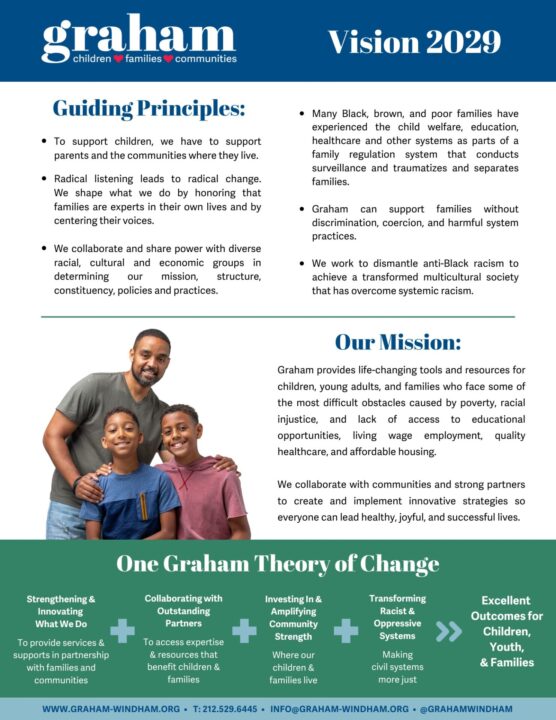
Moving Forward: Graham’s Vision 2029
By: Kimberly Watson
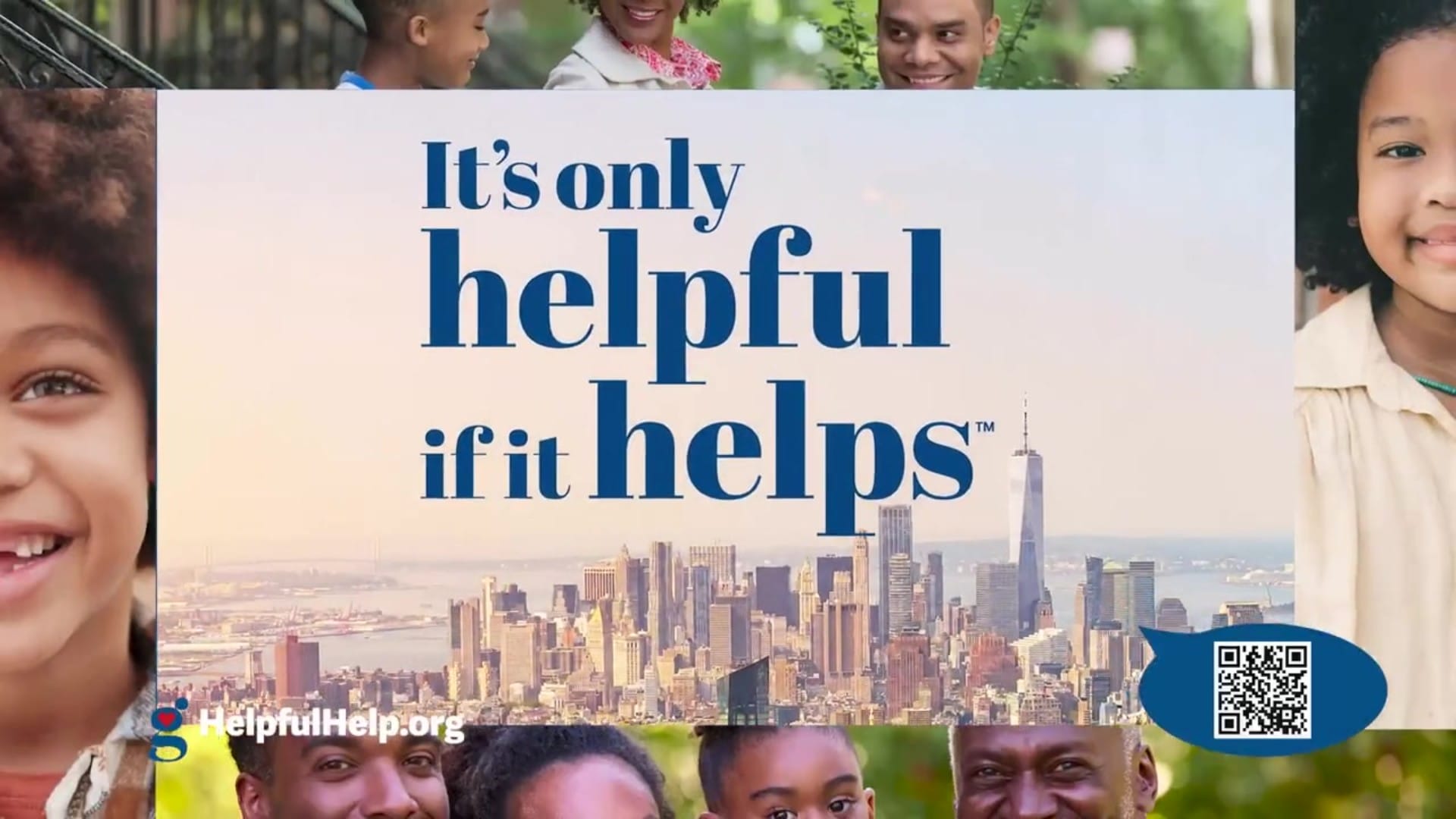
Give the gift of helpful help! Donate to Graham to support innovative strategies that fight poverty and racial injustice.
For more than 200 years, Graham has offered different supports and services. Over time, we have provided day care, community centers, afterschool, camps, and mental health, among other supports. Throughout that time, one consistent thread has been out-of-home care for children. When I came to Graham, almost 15 years ago, we operated one of the largest foster care programs in New York state, with children living at our residential campus in Hastings-on-Hudson as well as in foster homes.
It was about that time that we started a conversation about why so many of the children and families in foster care were Black and brown, and we looked closely at the outcomes for children. They weren’t good. We started trying to fix what we could. We developed practices to help children in foster care reunify with their parents as quickly as possible, or find adoptive families if needed. We closed our residential campus, provided foster care for fewer children, and increased our supports for families. We developed roundtables of parents and youth and developed and implemented some of the supports they told us they wanted and needed.
We developed Graham SLAM coaching to address the educational outcomes for young adults, and we developed our Family Success Initiative to help families reunite as quickly as possible. And the outcomes improved.
But that still didn’t get at the root of the problem. As we’ve listened – radically listened – we’ve heard from parents who have been impacted by the child welfare, education, healthcare and other systems. Our staff have shared their own experiences of their fears of interacting with systems. Black and brown parents are afraid to seek needed help because of the fear that they might be unjustly reported for child neglect or abuse.
In New York City, over 52,000 parents are investigated each year. Most investigations involve Black, brown, and poor families and only 22% result in credible abuse or neglect. Black children are 6 times more likely to experience an investigation than white children and 10 times more likely to be separated from their families through foster care.
Over the past year, we have had Reckoning conversations with impacted parents, advocates, and city officials. Our Vision 2029 is grounded in this work. Our attention to safety for children is right and we understand that for a variety of reasons, there are times when a temporary out-of-home placement is the best intervention. But when family separation is unnecessary, families are harmed in the name of protecting children.
Since our founding, the heart of Graham’s mission has been supporting children, families, and communities. We can, and we must, accomplish this goal without discrimination, coercion, and harmful system practices.
Donating to Graham means supporting children, families, and communities with life-changing “helpful help.” Your support allows us to create innovative strategies to fight poverty and racial injustice.
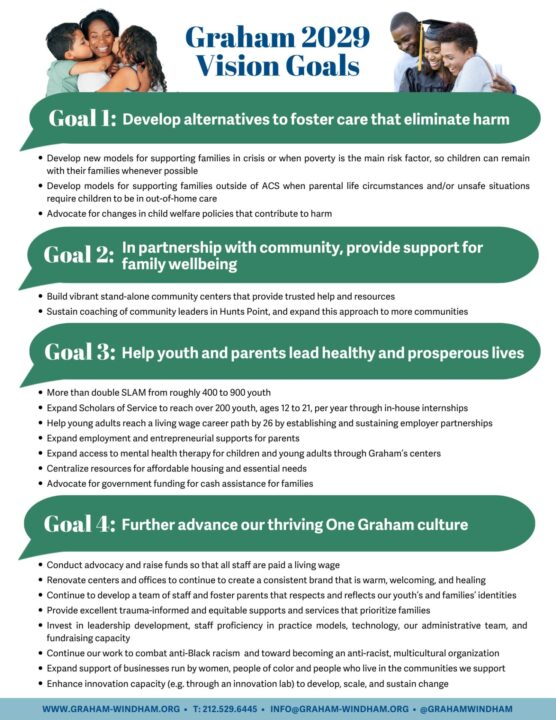
As part of our Vision 2029 plan, Graham will work with partners to develop new family and community supports that can become national models to ultimately replace the child welfare system.
We will join in advocacy for changes in child welfare policy and practice that will prevent unnecessary investigations and instead provide supportive responses to families in need.
We are entering the next chapter of Graham’s story, creating innovative strategies to help children, young adults, and families lead healthy, joyful, successful lives. We hope you will join us.


Contact Form
Get in Touch
Have a Question? Reach out!
Have questions? We’re here to help! Please use the contact form so that we can direct your request to the right people.